George Jackson on ‘the 1%’ and ‘the 99%’

By Steve D’Arcy

The idea of a class struggle between ‘the 99%’ and ‘the 1%’ is Marxist in origin, having been introduced by Black Panther Party member, George Jackson, in the early 1970s. More recently, of course, it reappeared in the discourse of the ‘Occupy’ movement, where it infused a certain type of class politics into the self-understanding and public profile of the movement.

georgejackson-by-Santiago-Mazatl
George Jackson, 1941-71 (art by Santiago Mazatl)

Jackson on the 99 percent

In his posthumously published 1972 book, Blood in My Eye, Jackson wrote: “Revolutionary change means the seizure of all that is held by the 1 percent, and the transference of these holdings into the hands of the remaining 99 percent” (p. 9). (Note: all page references are to George L. Jackson, Blood in my Eye [NYC: Random House, 1972].)

No one doubts that Jackson strongly identified with Marxism. “I met Marx, Lenin, Trotsky, Engels, and Mao,” he wrote in his other book, Soledad Brother, “and they redeemed me.” But is this way of understanding the fundamental antagonism between the ruling class and ‘the people’ ultimately compatible with Marxist theory? Some people who identify with Marxism are doubtful. They suggest that the blunt contrast between the 1 percent and the 99 percent is “fundamentally too vague to be useful as an analytical tool.”

For some, the objection is a matter of arithmetic: the ruling class, they say, actually comprises more than 1% of the population. But this objection seems to miss the mark, because no one (including Jackson) intends the formula to be understood in such a hyper-literal way, as a numerical estimate of the exact ratios. Rather, the notion of the 1% signifies the tiny minority of people whose wealth and power vastly exceeds that of most people. This small ruling elite arguably makes up the main adversary of the oppositional movements of the exploited and the oppressed. In the same way, the 99% should not be mistaken for a precise numerical formula. It simply points out the antagonism in principle between the profit-motivated ruling class and all of those many millions of people whose well-being is sacrificed and whose aspirations are thwarted by the systems of power that impose oppression, exploitation and alienation on the bulk of humankind, in a variety of ways and to varying degrees.

Marx on the ‘Immense Majority’ and the ‘Nine Tenths’

Karl Marx, being rather more upfront about the irrelevance of numerical precision in this context, referred (in the 1848 Communist Manifesto) to this vast segment of society simply as “the immense majority.” He described the anti-capitalist movement as “the self-conscious, independent movement of the immense majority, in the interest of the immense majority.” Elsewhere in the same work, he got more specific, identifying this movement with the 90%, subtracting nine percentage points from George Jackson’s catch phrase.

In Marx’s words,

“You are horrified at our intending to do away with private property. But in your existing society, private property is already done away with for nine tenths of the population; its existence for the few is solely due to its non-existence in the hands of those nine tenths. You reproach us, therefore, with intending to do away with a form of property, the necessary condition for whose existence is the non-existence of any property for the immense majority of society.”

Should we conclude that, precise numbers aside, Marxism can well accommodate the basic thrust of Jackson’s 99% phrasing, give or take a few percentage points? Perhaps. But there are further objections to consider.

Differentiation within the 99%

A second objection is that the formula glosses over, or even actively conceals, antagonisms that exist within Jackson’s “99%,” or indeed within Marx’s “nine tenths.” There are, for instance, class differences within what Jackson calls “the people,” dividing working-class people from middle-class people, such as professionals, managerial employees, and small business owners. These middle-class people are not part of the investor class (the 1%), but they are not really or entirely part of the working class, either. Marxist theory labels these intermediate class positions “contradictory class locations.” (It should be said here that the upper echelons of the professional, the managerial, and the small-business classes actually overlap or merge with ‘the 1%’; conversely, at the low-paid and precarious end, the line between these ‘intermediate’ groups and the wider working class becomes blurred. I can’t explore these nuances in this article, however.)

Importantly, the interests of ‘professionals’ can sometimes clash with those of workers, because professional labour is partly de-commodified by guild-like ‘associations,’ like the ‘medical associations’ of doctors and the ‘bar associations’ of lawyers, which create a partly distinct set of interests and political priorities, as well as distinct advantages, notably more autonomy at work and higher pay and status. In the same way, although only the richest upper-level managers gain entry into the 1%, people in lower- and middle-level managerial or supervisory jobs can find that their interests diverge from workers in very direct and clear ways, since their work may entail hiring, monitoring, and disciplining workers. Finally, people who own small businesses or family farms, very few of whom could plausibly be seen as members of the ruling class, often count on hiring low-paid and precarious labour as part of their business model. In these ways, there can be class conflict within the 99%, and the phrase seems to downplay, if not to deny this possibility.

In the same vein, other kinds of antagonism or tensions within the 99%, which are just as important, also need to be taken into account. For example, there are entrenched hierarchies that differentiate women from men; settler populations from Indigenous peoples; non-racialized from racialized groups; and so on. These hierarchies of systemic advantage and disadvantage within “the 99%” seem to some people to cast doubt on the usefulness of the catch-all phrase, ‘the 99 percent.’

It would be foolish to deny the seriousness of these criticisms, and no doubt we should keep them in mind at all times, to avoid turning Jackson’s 99% concept into a source of obfuscation and confusion. But it is worth noting that Jackson did not see these two points as being in tension. He was alert to both the possibility of a broad anti-capitalist alliance (addressing the grievances and aspirations of the 99%), and the necessity to acknowledge and address actual or potential conflicts of interest and aspiration within that proposed alliance.

Just after highlighting the fundamental clash between the 1% and the 99%, Jackson notes that “we must understand the racial complexities that exist” (p. 11); he highlights the importance of “internal colonialism” (p. 10); he notes that African-Americans are, but whites are not, subjected to routine police violence; he highlights the political differentiation between rightist and leftist workers (p. 63); and so on. But he sees these “complexities” as posing a political challenge for the oppositional struggles, a task to be taken up by the broad anti-capitalist movement: “to devise a policy,” that is, a program, “which takes account of…racism,” as well as colonialism, sexism, class differentiation, and other sources of potential divergence and conflicts of interest. This, he suggests, is the common task of all “sections of the left revolutionary movements” (p. 11).

If the jargon of the 99% and the 1% makes it harder to “devise a policy” within the anti-capitalist movement that can “take account of” the “complexities” and internal antagonisms that do (or threaten to) obstruct the emergence of a common front against the ruling class and its system, then we should dispense with Jackson’s formula. But, in a time when a broad, differentiated yet united movement against the system seems so sorely lacking and elusive, it may be that what we need most is to reawaken the very ambition, now largely absent, to construct an anti-capitalist alliance that draws in a wide array of forces, while recognizing the autonomy and distinct integrity of movements that cannot be simply collapsed into a single, undifferentiated super-movement. Alliances, by definition, are forms of coordination and strategic convergence of differentiated forces. They are not fusions that deny or suppress the specificity of different participating organizations, groups and projects. Nevertheless, an alliance entails a process of realignment, in which partnered forces assume a coordinated posture of common opposition to a shared main adversary.

George-Jackson-Lives-The-Black-Panther-newspaperEnduring Insights

It is worth recalling at this point that Jackson was a Leftist of a different time and place, when the level of struggle was much higher, and the political debates on the Left were linked intimately to the construction of mass organizations and the conduct of broad-based and militant popular struggles. We should not succumb to nostalgia, but it can’t escape our notice that Jackson wrote at a time when one still spoke of “forging alliances,” the confluence in struggle of large social forces, not just about “being an ally,” which is understood nowadays to be a process of personal growth undertaken largely by individuals (as opposed to mass organizations, movements or classes). Today, terms like “alliances,” “liberation movements,” and “revolution,” have largely dropped out of the activist vocabulary (examples: 1, 2), so it is a challenge for some to understand Jackson’s mentality and his strategic sensibility. But Jackson wanted to build — starting right away — a militant mass movement that could topple capitalism, imperialism and all forms of oppression and exploitation. His concern wasn’t how to live together within the systems and constraints of capitalism, racism, sexism and imperialism, but how to destroy them, by means of a broad-based popular struggle from below: what he called “the protracted war of the worker bees” (p. 83).

It was, I suspect, just this concern — the concern to construct, precisely on the basis of our insistence on “the complexities,” a broad but militant anti-capitalist alliance — that motivated Jackson’s introduction of the formula of the 99% versus the 1%.

There is no doubt that Jackson well understood the magnitude of this ambition. And he worried that revolutionaries might be tempted to stop short in the pursuit of it:

“If the 1 percent who presently control the wealth of the society maintain their control after any reordering of the state, the changes cannot be said to be revolutionary….If the 1 percent are simply displaced by another 1 percent, revolutionary change has not taken place….A social revolution after the fact of the modern corporate capitalist state can only mean the breakup of that state and a completely new form of economics and culture” (p. 9).

In this respect, too, Jackson’s revolutionary spirit foreshadowed what was best in the Assemblies movement, which spread from North Africa to Southern Europe, and eventually to Zuccotti Park and beyond, with its resolute repudiation of official politics and its zeal to create the new.

To be sure, there are large parts of George Jackson’s political strategy that we can clearly see, at least in retrospect, to have been doomed to failure. In particular, his support (e.g., pp. 66-70) for what I have described elsewhere as “the clandestine cell model of armed struggle,” which he depicted as the basic form of revolutionary politics in our time, proved to be disastrously mistaken. Not all of his proposals have aged equally well. But his passion to construct a broad anti-capitalist alliance of the 99% against the 1% seems to be one thing that George Jackson got exactly right.

Why Solidarity Matters

It is widely claimed, especially by marxists, that working-class people have both an interest in rebelling against capitalism, and a capacity to overturn the system by means of their own concerted action. I, too, endorse this claim.

But, supposing it’s true that workers would benefit from rebellion, why do they in fact seem so reluctant to rebel? Why is anti-capitalist revolt both rare and, by and large, relatively unpopular, at least in most parts of the world?

A common answer is that working-class people do not rebel because they are in the grip of an ideology, relentlessly promoted by schools, mass media and the culture industry. According to this theory, the ruling ideas are those of the ruling class, and the hegemony of pro-capitalist belief systems and value systems overrides the class interests of workers, leading them to embrace an alien, bourgeois world-view. In short, the compliance or acquiescence of workers is explained in terms of their alleged internalization of a conception of society that undermines their willingness to revolt against the system that exploits and oppresses them. According to this view, workers are behaving in an irrational, self-defeating way to the extent that they refuse to revolt. But how likely is it that they would persistently act in ways that are self-defeating? There’s something about this explanation, the “ideology” theory, that just doesn’t ring true.

Another explanation appeals to affluence to explain the absence of revolt. Maybe relatively highly paid workers — the “labour aristocracy” — are “bought off” by the system, because they benefit from it in ways that lower-paid workers do not. The problem with this view is that, like the “ideology” theory, it assumes that at least the lower-paid workers are acting in self-defeating ways whenever they fail to carry out a revolt that they would benefit from. Again, it is hard to see why they would behave in that way for a long time, decade after decade, if the whole time they had more to gain from acting otherwise.

I think we can bring out what both the ideology theory and the labour aristocracy theory are missing, by presenting a kind of parable, which conveys vividly the predicament of the workers’ movement today. (Note that, as to the substance of the views conveyed in the parable, I claim no originality; many social scientists have raised these points about rebellion and rationality, in more or less similar ways, for the past 40 years. See Heath 2000, for a recent application.)turkey

Imagine that a passenger jet is carrying 200 passengers. Two of the passengers, however, have used makeshift knives to commandeer the plane. Call them the 1%. Their intention is to use their position of power to extract money from the others, under the threat that non-cooperating passengers will be penalized in various ways, such as by being denied food or a proper place to sit. Conversely, the most cooperative passengers would be given advantages, including extra comforts and more freedom to move around. We can call the penalized passengers, “the worse off,” and the rewarded passengers, “the better off.”

It occurs to many, perhaps even to all of the passengers that 2 hijackers, in spite of the weapons that they have at their disposal, could easily be overpowered by the combined force of 198 others. And yet, no one challenges the hijackers at all. But why not?

Should we imagine that they are lulled into complacency and apathy by the comfort of their seats? Could it be that they are too immersed in the on-flight movie that is being shown on screens throughout the plane?

No. Their ready compliance is due neither to their level of comfort, nor to the distractions of the entertainment they are allowed to enjoy. Instead, what happens here is what is known as a “collective action problem.” A collective action problem exists whenever the action that would be most advantageous to a group of people, were they to cooperate with one another, is not advantageous to any of them individually in the absence of such cooperation. As a result, each of the individuals is in the position of being reluctant to “stick their necks out.” In my passenger jet case, no one tries to overpower the hijackers, because doing so alone would be at least self-destructive (because they would fail, and then suffer penalties, ending up not better off but worse off), if not suicidal. It is only advantageous to attack the hijackers if enough of one’s fellow passengers also do so, in the same way and at the same time. If that sort of large-scale coordinated response is unavailable, it is fruitless to try to confront the hijackers one or two passengers at a time. For each individual passenger caught in this situation, the most advantageous thing to do is to try to make the best of a bad situation. But the only way to do that is to try to be one of the most compliant passengers, in the hope that one can thereby gain entry into the “better off” group, rewarded for acquiescence. After all, the hijackers, who are now in a position to confer benefits and harms on the other passengers, have promised extra comforts and freedoms to the most compliant passengers. While attacking the hijackers will surely make one worse off, currying favour with them might actually improve one’s position.

To be sure, if rebelling against them seemed likely to end the whole ordeal, most of the passengers would probably be willing to take that risk. They would have a strong incentive to do so, as long as the great majority of the other passengers could be counted upon to stand shoulder to shoulder with them in this struggle. But in the absence of a coordinated, large-scale response, rebelling as individuals, in ones and twos, is just plain irrational and self-destructive. It simply can’t succeed. No doubt a few passengers will try, hoping to set an example for the others, perhaps expecting to spark a wider revolt. But when the others see how easily the rebellion is crushed, the most likely effect will be to reinforce the impression of most passengers that the only option is to make the best of a bad situation, doing what they can to please the hijackers in order to extract some relative advantages.

This, in a nutshell, is the structure of the situation that the workers’ movement finds itself in today. Collectively, we have the potential power to topple the ruling class and its systems of exploitation and oppression. By large-scale withdrawal of labour, and refusal of socio-political compliance, the workers’ movement (that is, the oppositional struggles of the exploited and the oppressed) could bring the system grinding to a halt and deprive elites of the social basis of their power and authority. Moreover, we would benefit greatly from doing so. And yet, in practice we seem powerless to resist. Indeed, when we do resist, our efforts usually fall flat, since it is clear both to ourselves and to our adversaries that we are unable to mobilize our forces on the scale and with the intensity, coordination and persistence needed to pose a real challenge to the system.

At the very centre of the crisis of the Left is a collective action problem, essentially identical to the one that plagues the passengers on that flight. Small groups here and there try to put up a fight. But they are easily defeated by the superior strength of the ruling class. Were all of the exploited and oppressed, or even most of them, to challenge the system at once, in a sustained and coordinated way, there is no doubt that the rebellion could prevail. But this kind of coordination does not exist, and everyone knows that it does not exist. As a result, revolt against the system just does not seem like a plausible or appealing course of action for the vast majority of people. Why stick your neck out, when you know you cannot prevail?

What is the way forward, in the face of this impasse?

What is missing, obviously, is coordination. Each individual or isolated group needs to be able to trust all the others that, when one person or group sticks their neck out to fight, all the others will “have their back” and take up the fight. This is the missing ingredient. But how can we begin to address this “atomization,” this sense that we all stand alone, wishing we could stand together?

Traditionally, the workers’ movement knew exactly how to address this problem. It systematically cultivated, and even “enforced” in certain ways (above all, during a strike or boycott), a set of norms and practices that reinforced habits of reliable coordination: the movement took great pains to inculcate the familiar “proletarian values” of cooperation, mutual aid, and solidarity. The power of the workers’ movement rested on the widely shared understanding that “an injury to one is an injury to all.” Injustice anywhere was recognized as a threat to justice everywhere.

Unfortunately, there has been a long term process of “decomposition” of these forms of solidarity and cooperation, brought about by changes within the workers’ movement itself (the bureaucratization of unions, the displacement of self-organized practices of mutual aid by professionalized, state-administered social services), the legal reconfiguration and ‘domestication’ of ‘labour relations,’ the reorganization of workplaces to disempower and de-skill workers, the reordering of the forms of life available to workers (suburbanization, car culture, etc.), and the enclosure and commodification of most opportunities for recreation and the production and consumption of popular culture, among many other factors. The effect of all these (and other) transformations has been to weaken the grip of expectations of mutual aid and reciprocal solidarity within and among the organizations of the labour and social movements. The grip of those proletarian values has steadily weakened, to the point where now the “bourgeois” norms of competition, social climbing, and careerism have come — paradoxically — to prevail even within the working class, which for so many generations scorned these ruling-class aspirations and counterposed to them the socialistic ideals and material practices of solidarity and cooperation.

In the wake of this long-term process of decomposition, what is needed now is a similarly long-term process of recomposition. The exploited and the oppressed have to take up the challenge of constructing new forms of solidarity, cooperation and mutual aid, while reinvigorating (where possible) the old forms. One part of this will be the emergence of new styles of struggle, more effective in today’s context than the domesticated and de-fanged varieties of collective action that now predominate, too often integrated into the official political process or the state-supervised labour relations regime. But just as crucial will be the cultivation of effective vehicles of cooperative production and distribution that can draw us out of the seemingly totalitarian reach of market and commodity relations, on the one hand, and bureaucratic ‘command-and-control’ systems, on the other hand. A resurgence of grassroots collectivism could offer a much-needed reminder of our capacity as human beings to support and sustain one another, outside of and against capital and its state. Community-based, self-organized forms of cooperation and “solidarity economics” not only could exist, but they already do exist, albeit under constant pressure to collapse into the capitalist forms of organization that they attempt to eschew. No less important, the workers’ movement of today must learn to push back against the total privatization and enclosure of popular culture, by finding ways to produce and share cultural expressions that articulate the grievances and aspirations of the exploited and the oppressed in ways that are harder to recuperate or co-opt within the confines of capitalism and commodification.

The Left should not allow its anxiety in the face of non-statist forms of “localist” cooperation and solidarity to discourage it from offering much-needed support for so-called ‘prefigurative’ forms of working-class self-organization. The latter take many forms, from cooperative workplaces and popular assemblies to community gardens and collective kitchens. The absence of red flags and anti-capitalist manifestos should not obscure the fundamental antagonism between these egalitarian and democratic projects and the logic of capitalism that they so obviously reject.

Only a concerted and persistent commitment to this process of renewing and regenerating the shared sense that “an injury to one is an injury to all” can begin to turn the tide, reviving the deep bond of mutual trust and commonality of fate that nourished the struggles for justice and democracy in decades past.

In what sense did Marx propose to “smash [brechen] the state”?

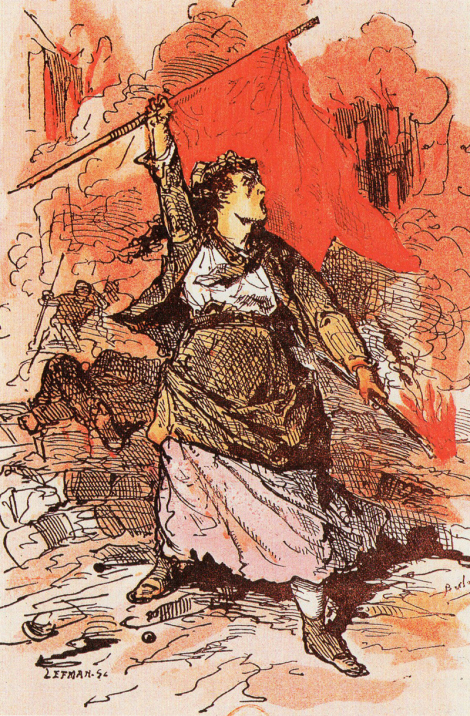
It is well known that one of the formative political experiences of Marx’s life was his effort to mount a public defence of the Paris Commune of 1871. The Commune was the most dramatic and, to Marx, the most inspiring anti-capitalist revolt of his time. As the Franco-Prussian War wound down, the workers of Paris rose up and deposed the French State’s authority, replacing its rule with a new form of popular self-organization that, in Marx’s memorable phrase, did not reproduce or reorganize the state, but “smashed” it.

But what did Marx mean by “smashing the state”? And what was the nature of this Commune that he held up as a model for anti-capitalist revolution?

Should we think of the Commune, as some do today, as a “workers’ state”? Or should we think of it as, on the contrary, a form of participatory-democratic, specifically anti-statist, community-based working-class self-organization?

Defender of the Commune, Paris 1871

Here, Marx and Engels actually make it hard to say quite which interpretation they would endorse, because sometimes they use language encouraging the statist interpretation of the Commune, and sometimes they deny outright that it was a state, “in the proper sense of the word.”

A typical statist reading can be found in a comment by Engels, in 1891, that the Commune “shattered” the “former state power,” and “replaced” it with “a new and truly democratic one” (628; page #s refer to Tucker, ed., Marx-Engels Reader, 2nd ed.). But this suggestion, that the Commune created a “new and truly democratic” state, seems to contradict something Engels said in 1875, when he asserted bluntly that the Commune “was no longer a state in the proper sense of the word.” Indeed, so insistent was he that the Commune was not a state in the proper sense, that he proposed, speaking on behalf of Marx and himself, that socialists should “replace [the word] state everywhere by Gemeinwesen [community], a good old German word which can very well convey the meaning of the French word, commune” (Letter to Bebel, 1875).

For his part, Marx also seemed ambivalent. On the one hand, he seemed to be alluding to the state when he called the Commune “a working-class government” (634). On the other hand, he regarded the most important lesson of the Commune to be the insight that “the working class cannot simply lay hold of the ready-made state machinery and wield it for its own purposes” (629). This insight, that we can’t just “take power” by putting the workers’ movement at the helm of the administrative, coercive and legislative apparatuses of the capitalist state, was in fact the only correction to the argument of the Communist Manifesto that he ever explicitly proposed. The Manifesto had failed to insist that a working-class revolution would have to smash the state, rather than taking it over, Marx concluded.

Rather than getting bogged down in verbal technicalities about the meaning of the word “state,” let’s look at what Marx thought the Commune was doing, and try to see, substantively and concretely, what he meant when he said that it smashed rather than taking over the state.

To save time, I’ll get right to the point: As Marx says, “While the merely repressive organs of the old governmental power were to be amputated, its legitimate functions were to be wrested from an authority usurping pre-eminence over society itself, and restored to the responsible agents of society” (633). In other words, the state power, exercised from above, was replaced by community control from below. Thus, the Commune “got rid of the standing army and the police,” according to Marx (632). “The whole of the educational institutions,” he adds, “were cleared of the influence of…the State” (632). “Judicial functionaries,” he tells us, “were divested of” their “sham independence,” and placed under community control. Or, as he vividly puts it, “like the rest of public servants, magistrates and judges were to be elective, responsible, and revocable” (632). Moreover, and also like all other public servants, they were to be paid an average worker’s wage (632). Both the legislature of professional politicians and the administrative branch of government were to be fused (632) into the Commune’s democratic assembly, delegates to which were, once again, “elective, responsible, and revocable,” and paid the prevailing worker’s wage.

The basic idea of smashing the state, as Marx uses this term, is evidently quite clear from these passages, and countless others like them in Marx’s main work on the Commune, and his main contribution to so-called “state theory,” The Civil War in France. What he means by “smashing the state” is that the various elements of state power – the coercive apparatus; the administrative apparatus; the legislative-executive apparatus; and the judicial apparatus – this whole system of state power is either (a) abolished outright (“amputated”), or (b) in cases where it has what Marx calls “remaining legitimate functions,” these are placed under direct community control by the working class, from below.

Community control, as Marx understands it, includes four elements: that all functionaries are paid the prevailing wage in the community, and are elected by, accountable to, and removable by, the community. Thus, smashing the state, for him, means two things: abolition of all illegitimate functions, and subordination of legitimate functions to direct popular control from below.

Now, every reader of Marx will agree that he regards this process as a “conquest of political power” by the working class, or as some now say, the 99%. But is it a state? Certainly workers were governing; they were “dictating” the terms of social cooperation. Workers ruled Paris for the two months that the Commune lasted. But all of this is consistent, perhaps most consistent, with Engels’ formulation: that the Commune was “no longer a state in the proper sense of the word,” but a form of community-based working-class self-organization, or what Marx called “the proletariat organized as the ruling class” (490).

Dictatorship, yes; state, no.  Conquest of (social) power, yes; conquest of state power, no.

A Self-Organization Strategy for Revitalizing the Left

[This is a revised version of a contribution to the Rabble.ca series, “Reinventing Democracy, Reclaiming the Commons.”]

What happened to the North American radical Left? Why is it that, even now, when capitalism seems so obviously unappealing, unsustainable and unfair, the far Left cannot mount a more serious challenge to the Right or its grim austerity agenda?

What became of the Left’s former ability to mobilize large numbers of people into powerful social movements, to inspire working-class people with appealing visions of post-capitalist alternatives, and to strike fear into the hearts of elites who once worried that the radical Left posed a credible threat to their power and privilege?

If we are serious about figuring all this out, and reversing the Left’s present trajectory of decline, we have to be willing to take some responsibility for our predicament. We can’t just blame the ‘propaganda’ circulated by the corporate media, the repressive role of the police and the courts, or the way electoral systems are stacked against our efforts to promote social and environmental justice and political and economic democracy. The news media, the police, and state institutions have always waged a determined struggle against the radical Left; but the Left used to be able to overcome these obstacles and make real gains, building powerful mass movements that sometimes racked up real victories. Above all, a range of avowedly anti-capitalist organizations were once able to claim the active allegiance of hundreds of thousands of people, and the passive sympathy of millions, but at least in North America this broad-based support for anti-capitalist politics has long since collapsed.

The Left’s Role in Its Own Decline

What has the Left done, or failed to do, that might have hastened or exacerbated its own decline, and what can we do today to help turn things around?

There is, of course, a conventional answer to these questions. Some people on the broad Left, and almost everyone on the Right, would say that the Left’s historic error was to articulate a political vision (‘socialism’) that strayed too far from capitalism. Its supposed aim to introduce democratic and egalitarian economic planning, they say, made socialism unable to handle the overwhelming demands of information-processing that arise in a complex modern society. Only markets, commodification, and profit-motivated investment decisions can handle these demands, according to this view.

But I would argue that the real story is almost the exact opposite of this more familiar one. The real-world experiments in ‘socialism’ during the 20th century did not fail because the distance that separated them from capitalism grew too great, making them unworkable. On the contrary, they failed because the proximity between those efforts and capitalism made these ‘socialisms’ – Stalinism and social democracy – too difficult to distinguish from the capitalist system that they were supposed to replace. These supposedly socialist political projects actually embraced most of capitalism’s worst features: its bureaucratic mode of governance, its technocratic approach to designing and implementing public policy, its hierarchical and authoritarian norms of workplace organization, its Realpolitik patterns of international relations, its cultural celebration of productivity and growth as ends in themselves, and its elitist understanding of who is best suited to exercise political power and spearhead social change.

At the heart of the problem was the Left’s often uncritical embrace of one of the most oppressive, disempowering and alienating institutions that most working-class people ever have the misfortune to interact with in their lives: the modern state. At some point, the Left dropped its former aim of encouraging the ‘self-emancipation’ of working people, and replaced it with an aim that to most people seems like its opposite: technocratic ‘public administration’ by state agencies.

studentassembly
Student assembly, Quebec, 2012

This shift, from the anti-statist ‘community-based socialism’ that dominated the early Marxist, Owenite, Guild-socialist, syndicalist and anarchist Left in the 19th and early-20th centuries, was replaced in the years after the First World War by the two most influential forms of ‘socialism’ in the 20th century: statist command planning, typified by the USSR, and Keynesian welfare state expansionism, typified by European social democracy.

In the course of this fateful shift, the Left gave up almost entirely on the emancipatory promise of liberation from alienation, exploitation and bureaucratic administration that had once been its stock in trade – a promise which had only a few decades earlier led European radicals to embrace the bold ‘smash the state’ ethos of the Paris Commune. In place of this earlier promise of sweeping social reconstruction based on popular self-organization from below, the post-WWI public-administration Left now promised two things: ‘development’ and ‘rising living standards.’ For a while, both Stalinism and social democracy seemed able to deliver on these promises. Later, notably during the structural crisis of Keynesian demand-management capitalism in the mid-1970s and the stagnation crisis in Eastern Europe during the 1980s, these promises began to ring hollow.

But the more fundamental problem wasn’t that the Left could no longer deliver on its promises. The problem was that it was making the wrong promises altogether. The ideal of a community-based, egalitarian and participatory economic democracy that had once inspired millions had been replaced with an unappealing vision of a regime of public administration and economic management – whether Stalinist or social-democratic – that delivered ‘benefits’ to a passive, alienated, but well-fed populace.

This ‘administrative’ vision of a post-capitalist world is not utopian or unattainable. But why would anyone be inspired to struggle for it? This, I believe, is the question that the Left must address if it is to revitalize its project and recapture the allegiance of people who have learned to associate the radical Left with government bureaucracy and alienating public administration.

A Left That No Longer Identifies With The State

Having made this fateful wrong turn so long ago, what can the Left do today to set a new course, to restore the viability and the appeal of its project?

What the Left needs above all is to rupture its identification with the capitalist state. Government is not an actual or potential ally of the Left against Big Business. In part this is because, especially in this neoliberal epoch, government is in fact already an arm of Big Business. But more importantly, it is because the bureaucratic structures of the capitalist state are incapable in principle of serving as a vehicle for the self-liberation of people who aspire not to be administered by a welfare-maximizing state apparatus, but to participate in the democratic self-organization of their own workplaces and communities. What is needed, in short, is a reassertion of the classical leftist ideal of a community-based socialism, a socialism of popular self-organization and horizontal democracy, not one of public sector maximalism.

In part, that means replacing the utilitarian and technocratic images of a post-capitalist social order with more appealing images of radically democratic forms of community-based egalitarian economic democracy. But, in more immediately practical terms, it means a strategic reorientation of the Left: a turn away from the habit of engaging primarily with state institutions (parliaments, regulatory agencies and the welfare state), toward engaging primarily with grassroots, community-based forms of popular self-organization.

A Self-organization Strategy

pb
Participatory budgeting in Porto Alegre.

The Left, in other words, must turn its attention back toward the community-based, self-organized domain of “civil society”: union locals, cooperatives, social movement organizations, mutual aid projects, popular assemblies, and other community associations. These expressions of grassroots democracy and popular self-organization – operating independently of both the market economy and the state – offer the Left the crucial benefit that they do not replicate the alienating and disempowering character of corporations and governments (although the Left is unfortunately overpopulated with bureaucratic and staff-led union and NGO apparatuses that today emulate the administrative systems of elite institutions). Instead, these grassroots organizations embody the ‘every cook can govern’ spirit of the classical (pre-WWI) Left.

When the Left does engage with the state, as it sometimes must, its default demand should be to transfer power from corporations and the state to grassroots, self-organized civil society. Such a self-organization strategy is arguably already implicit in the notion of a community-based socialism. For example, whereas a statist strategy would demand that the government’s budget adopt welfare-maximizing priorities, a self-organization strategy would demand that budgeting power be ceded to a grassroots participatory budgeting process, centrally involving open public assemblies. Whereas a statist strategy would demand ‘public housing’ owned and operated by the state, a self-organization strategy would demand that state funds be used to establish democratically self-governing non-profit housing cooperatives, collectively owned by their members. And whereas a statist strategy would demand ‘nationalizing’ banks as ‘public enterprises,’ a self-organization strategy would demand that banks be dismantled and reconstructed as genuinely democratic and member-controlled financial cooperatives (‘credit unions’), operating in the public interest. This transfer of power and control from corporations and governments to self-organized civil society associations should be seen as the main aim of the Left. From this point of view, ‘winning’ for the Left means replacing the power and prerogatives of corporations and governments with empowered, participatory, and self-governing forms of community-based self-organization.

How We Resist Neoliberalism

There is no doubt that a community-based self-organization strategy for the Left raises a number of difficult questions. Above all, it poses a very serious set of questions about how the radical Left should fight back against neoliberalism, notably in its contemporary guise of the ‘austerity’ agenda. Given that neoliberalism’s primary policy aspiration is to privatize public services, and to replace public administration (the ‘public sector’ economy) with commodification (the ‘private sector’ economy), shouldn’t the Left be defending the state (the public sector) against neoliberal privatization?

What the Left needs in addressing this question is nuance. We have to be able to distinguish between privatization and collectivization, both of which are alternatives to public administration. For example, transferring control of a public (state-owned and operated) housing complex to a profit-motivated private landlord, in pursuit of the corporate/neoliberal agenda, is properly understood as privatization. But transferring control of that same public housing complex to the residents themselves, under pressure from grassroots popular mobilization, to be run as a non-profit democratic cooperative, is not privatization but collectivization. If we refuse to make this distinction, either by celebrating privatization as a victory against the state or by vilifying cooperatives as ‘neo-liberal,’ mistaking collectivization for a type of privatization, we fall into one of two familiar traps: the temptation to see the state as the main enemy, letting corporations disastrously off the hook, or (more likely among leftists) the temptation to align ourselves politically with the ill-fated project of ‘public administration socialism,’ in which the Left plays the role of supporting the capitalist state as a bulwark against corporate power.

This kind of mistake is at the heart of the Left’s historic failure to champion public autonomy and community-based self-organization against not only their corporate enemies, but their bureaucratic-statist enemies, as well. Once taking this path, the Left quickly finds itself defending the state against the negative experience of it that so pervades the lives of poor and working-class people, even to the point of championing the increase of taxes on workers as ‘progressive’ because it supports the state.

The Left, or at least the radical Left, needs to remember that its project by definition demands sweeping social reorganization and reconstruction from below. In pursuit of this aim, the Left may often need to tactically defend public services, run on a non-profit basis by the state, against the immediate threat of profit-motivated privatization, which we rightly oppose as a step in the wrong direction altogether. But ultimately, the Left must aim higher than state-administration: the Left must aim to replace both the profit-motivated private sector economy and the bureaucratically administered public sector economy, in favor of a community-based, democratic and egalitarian post-capitalist economic democracy. This means that we must admit the obvious: that publicly owned enterprises and public services offered by the capitalist welfare state do not meet the standard of public autonomy by any stretch of the imagination. Our project demands a community-based self-organization strategy, not a statist one. What we fight for is not a bigger, more expansive state, but more democratic and egalitarian forms of grassroots popular self-organization: a more participatory and community-based set of economic and political institutions, controlled from below by working people themselves.

Today, more than ever, we need a Left that can inspire hope, not just for a more productive and well-administered society, but for a freer, more democratic, less alienating society, controlled directly by its members, as opposed to being controlled by administrators, supposedly acting in the public interest. This ideal of a ‘community-based socialism’ was a vision that once united the entire radical Left – Marxists and anarchists, guild socialists and Owenites, syndicalists and council communists. There is good reason to hope that it could some day do so again.