A Layered Approach to Reading Marx

Those who still try to engage seriously in the work of reading Marx often find themselves grappling with a number of apparent ambiguities or indeterminacies that seem to inhabit the source materials in advance. Here, I can only mention a few of these, hinting at the scope of the problem:

  • Is Marx’s “social-scientific socialism” somehow “objective” in the sense of being value-neutral, or is it animated crucially by an interest to “change the world” and oppose injustice?
  • Is the “dictatorship of the proletariat” a prediction about how capitalism is likely to unravel and be displaced due to acute and escalating conflict between classes, or is it a political strategy proposed as maximally advantageous for those endeavouring (voluntarily, as it were) to effect revolutionary change?
  • Is the end of capitalism and its displacement by socialism “inevitable,” in a causal sense, or is it desirable (worth wanting), in a normative sense?

Readers of Marx, confronted by these apparent ambiguities or indeterminacies, tend to part company with one another, as different “schools” or “currents” of opinion align in favour of one reading or another, with little prospect of a convergence. There are, for instance, neo-Schmittian Marxists who oppose any notion of normative assessment, in favour of a narrow “Realpolitik” conception of social conflict. And conversely, there are “humanist” Marxists who insist on the fundamentally ethical nature of Marx’s challenge to capitalism and his insistence on the “universality” of the proletarian self-emancipation project. And both seem able to cite passages in Marx (or other classical marxist writers, like Engels, Luxemburg, Gramsci, Lenin, and so on), to support their views.bpp-photo

On one level, this seeming indeterminacy might be OK. Why, after all, should we favour convergence around an unchallenged official version of what Marx had to say? It seems that, whether we look at it in intellectual terms or in political terms, there is little to be gained by seeking to liquidate our differences of interpretation or emphasis. Quite the reverse, in fact: we can expect a greater fruitfulness and fecundity to accompany such conflicts of interpretation.

Nevertheless, it is always better, intellectually and politically, to strive for a sophisticated and mature, rather than a simplistic and naive understanding of any text, tradition, practice or event. And so, in the case of Marxism, we should approach this matter of indeterminacy with a critical and discerning eye, in the hope to shed some light on — if not the “right” version of Marx — at least the roots of our inability to agree about the contours of his theoretical contribution.

In this spirit, I want to urge upon Marx’s readers a general approach to examining and reflecting upon, not to mention deploying and relying upon, his core concepts and theoretical commitments. The approach that I advance here is to read Marx’s concepts as layered.

In what sense are Marxist concepts layered? In this context, I can only offer the most concise sketch of the idea. In a nutshell, my suggestion is that most of Marx’s key concepts (surplus-value, dictatorship of the proletariat, communism, and so on) operate simultaneously, and in a way that obeys a consistent logic, on three distinct levels, or in three differentiated but interconnected layers: the level of causal explanation, the level of strategic analysis, and the level of normative evaluation.

Thus, for instance, to understand the concept of “surplus value,” one has to grasp it, simultaneously, (1) as a causal-explanatory concept used to explain capital accumulation, and the source of profits, rent, etc., (2) as a strategic concept used to delineate a plausible collective agent of effective anti-systemic revolt, and (3) as a normative concept used to condemn capitalism as a system founded upon and continually reproducing injustice and dispossession.

Surplus value is only one example, however. Consider the concept of “the dictatorship of the proletariat.” It functions simultaneously (1) as an explanatory concept that licences predictions about causal dynamics likely to accompany any durable dissolution of capitalist hegemony, (2) a strategic concept pinpointing the most potent strategic orientation for a decisive struggle to wrest political power from the investor class and to establish institutions of working-class self-governance in the context of an acute social crisis, and (3) as a normative concept (“public autonomy”) that links anti-capitalist revolt to the moral ideal of a “social republic” in which the “immense majority” throws off the yoke of “a few usurpers” to establish, as Marx put it, “government of the people by the people.”

But simply listing these triple-layered readings seems only to underline the problem stated at the outset, the ambiguity and indeterminacy of Marx’s meaning. It doesn’t — yet — resolve or dissolve the difficulty. This, however, brings me back to my reference above to a “consistent logic” that relates these layers one to another in every such case. This logic has a structure which, luckily for those of us hoping to read him with due care, he meticulously spelled out in the pages of his second most important work (after The Civil War in France), namely, the first volume of Capital. In particular, he outlines the logic of conceptual layering in two key places: first, the “Afterword” to the 2nd German edition, and second, in the chapter on the labour process. In essence, it is a logic of labour, understood as negation of negativity by way of purposive, world-transforming praxis.

In the “Afterword,” Marx says that his mode of interpretation “includes in its comprehension and affirmative recognition of the existing state of things, at the same time also, the recognition of the negation of that state, of its inevitable breaking up; because it regards every historically developed social form as in fluid movement, and therefore takes into account its transient nature not less than its momentary existence; because it lets nothing impose upon it, and is in its essence critical and revolutionary.”

At this point, Marx is only telling us part of the story. He’s drawing our attention to one of (but not all of) the crucial elements of his approach to conceptualizing capitalism and anti-capitalist revolt: that it acknowledges the existing state of the system, but also its fluid movement. His approach to conceptualizing capitalism, in other words, highlights the system’s “diachronic” dynamism and instability as much as its “synchronic” coherence and regularity. In this sense, his “method” is “critical and revolutionary,” unlike the conventional social sciences, which tend overwhelmingly to depict the core institutions of present-day society as self-reproducing structures that gravitate toward stable equilibria (or other such schemas of stability and recalcitrance to popular contestation).

But a mistake lurks here, threatening to trap the unsuspecting reader. Does Marx think of capitalism’s “fluid movement” as directionless, in the way that Darwin regards evolution as directionless (that is, non-teleological)? No, he does not. There is more to be said about the precise sense in which Marx’s method is “critical and revolutionary.”

For this, we have to turn to the chapter on the labour process. There, he writes: The labourer “makes use of the mechanical, physical, and chemical properties of some substances in order to make other substances subservient to his aims….Thus Nature becomes one of the organs of his activity, one that he annexes to his own bodily organs, adding stature to himself.” And in this passage, among others in the labour process chapter, he reveals the key to his conceptual layering methodology: pursuit of a telos or aim can only proceed on the basis of insight into causal regularities, enabling their conversion from constraints into instruments for actualizing latent possibilities, i.e., “unleashing,” or unfettering, forces that already exist within a reality that still restrains their potentialities from being realized (prior to the intervention of praxis). Herein lies the bond that ties together Marx’s three layers: a reality to be understood (in its causal regularities), an ideal to be realized (defining a standard of success), and a plan for acting upon the former in order to actualize the latter (a plan that either works or doesn’t work, as a means of world-transforming practice, or labour).

In discussing the constructive activity of the architect, which he uses as a stand-in for human agency in general, Marx points out that the architect “raises his structure in imagination before he erects it in reality.” This is crucial not only to architecture, but also to critical social theory (Marxism), because it is only in light of — that is, under the guiding illumination of — the looming prospect of communal reappropriation (“expropriation of the expropriators,” the haunting “spectre of communism”) imagined as the orienting reference point of inquiry and practical engagement, that we know what to look for in the “momentary existence” of the prevailing situation that will unlock the secret of its “transient nature,” notably, its “inevitable breaking up,” its “crisis tendencies,” its “cleavages,” its latent, fettered forces and strategic vulnerabilities, etc. The opening up of this “continent” of possible knowledge, however, requires that we find the point of convergence between two variables: first, the mechanics of how the system reproduces itself, i.e., what Marx calls the “fetters” that presently hold at bay the construction of communism, and second, the disruptive “forces” that operate within the system-reproduction mechanics that can be brought to bear in order to “burst asunder” those “fetters” on “free development.” All of Marx’s thinking, or at any rate most of it, is rooted very specifically within this cluster, or rather this structure of concerns: the “negativity” (potentiality-withholding character) of the present order, as a system of fetters on forces of a possible, but denied liberation. Marx calls this structure of concerns “the materialist conception of history.”

Seen in this broader view, then, we can see that there is a stable connective tissue, a consistent logic, that binds together the explanatory, the strategic and the normative layers of each concept Marx deploys in the core of his critical theory. Consider again the concept of surplus value. He is only interested in surplus value because the illuminating prefiguration of communal reappropriation (the “haunting” spectre of communism) draws his attention to the existence of a (dys)functioning Achilles heel that, on the one hand, props up and enables the system to reproduce itself (explanatory layer), and on the other hand, exposes it to the vulnerability of unauthorized withdrawal, e.g., general strikes and other deployments of the power of workers to block the production of surplus value (strategic layer). But besides explaining the system and orienting strategies to attack it, surplus value is also a condemnatory concept, which exposes the fact that capitalist relations of exploitation fetter communal liberation (normative layer). The moral import of exploitation — that, in Marx’s formula, “the labour of the many becomes the wealth of the few” — is inseparable from what gives it a decisive explanatory import, and what thereby highlights a vulnerability of crucial strategic significance.

Once we get the hang of this three-layered praxis-logic (linking the causal regularity of an object to be acted upon, the pre-imagined normativity of an aim to be realized, and the strategic efficacy of an instrumental intervention to be carried out), the suggestion that Marx’s thought is ambiguous between a “social-scientific socialism,” a strategic orientation for anti-capitalist resistance, and a normative basis for condemning exploitation and oppression as moral injuries, seems like a naive and over-hurried failure to read Marx with sufficient care and attention.

When Marx says, “the philosophers have only interpreted the world; the point, however, is to change it,” what he means is this: We conceptualize capitalism as part of a complex labour of transforming it, and so our concepts don’t try simply to represent the system’s “momentary existence,” but also, and especially, to highlight the possibility of overthrowing it, of ensuring its “transient nature.” Accordingly, the rationality of each concept we deploy to “understand” capitalism is a function of its contribution to “the expropriation of the expropriators,” i.e., “the negation of the negation,” bringing the spectre of communal reappropriation to life, and thereby “proving the reality and power, the this-sidedness of [our] thinking in practice.”

An Exploited, Dominated, and Oppressed Class?

By S. D’Arcy.

In the 19th century, European workers used to refer to themselves as an “oppressed class,” an expression that came to infuse the jargon of revolutionary socialists in that time and place. In the Communist Manifesto (1848), for instance, Marx and Engels analyzed what they called “the antagonism of oppressing and oppressed classes.”

But what did they mean by this term, “oppression”?

In the Manifesto itself, “oppression” (Unterdruckung) seems almost interchangeable with what Marx later, in Capital, came to call “domination” (Herrschaft), a term he borrowed from Hegel’s Phenomenology of Spirit. The Manifesto refers to the “slavish existence” of “oppressed classes.” Being “oppressed” is contrasted with “ruling,” so that the counterpart of the oppressed class is the “ruling class” (herrschenden Klasse). The classes referred to by Marx as “oppressed classes” (unterdrückter Klassen) were, in essence, those subjected to rule by others, “a few usurpers,” or what we now call “the 1%.” In his later work, however, Marx came increasingly to emphasize the theme of “exploitation” (Ausbeutung). The working class was an “exploited class,” as well as a dominated one.

Exploited, yes. But oppressed too?
Everyone calls Foxconn workers exploited. But are they oppressed as workers, too?

I think it would fair to say that, in Marx’s work, and in the jargon of 19th century European socialism more generally, “oppressed” meant roughly, exploited and dominated. Accordingly, women were described as “oppressed” because they were exploited and dominated, subjected (as Lenin put it) to a form of “domestic slavery.” Subaltern nations, too, were said to be oppressed, on the same basis: they were exploited and dominated by colonial and/or imperial powers.

But early in the 20th century (not long after the First World War), Marxism as a vital political tradition became increasingly a phenomenon of the Global South. Between the World Wars, revolutionary socialism went into decline in the North Atlantic countries (Western Europe, Canada, USA), just as the influence of revolutionary socialism grew in the “periphery” of global capitalism, in places like East Asia, Southeast Asia, the Indian Subcontinent, the Middle East, North Africa, sub-Saharan Africa, and Central and South America. As the centre of gravity within Marxism shifted decisively toward the Global South, it was to be expected that its vocabulary would evolve. One of the ways it changed was that the concept of oppression was used less and less to refer to the working class, as the theme of exploitation came to the foreground of the marxist analysis of class, and the theme of oppression became more and more associated with the position of women, racialized groups, and especially oppressed nationalities.

At times, this contrast between class, as a form of exploitation, and gender, racial and national subordination, as forms of oppression, has been advanced as a clear point of contrast (rather than a subtle difference of emphasis). Some people, within Marxism, have suggested that workers are not “oppressed” as workers, but only as women, as people of colour, and so on, and that they are only “exploited” in their capacity as workers, not in these other dimensions. (Later, other groups were added to the ‘oppression’ side of this exploitation/oppression contrast: disabled people, the elderly, LGBTQ people, and others). Notably, the older, republicanism-inflected concept of “domination” seems to have mostly fallen out of the Left’s vocabulary, with the partial exception of anti-colonial contexts, where it still appears.

But, while we can perhaps understand how this contrast between exploited (but not oppressed) classes and oppressed (but not exploited) non-class ‘identities’ arose, we really should admit that it is founded on a mistake. The mistake seems twofold.

First, some of the groups on the oppression side seem clearly to be exploited. (Here I will confine myself to one example: women.) The fact that the domestic labour of women as women is exploited is well-established by social research (and common knowledge). This is clearly part and parcel of sexism, not just a manifestation of the generalized exploitation of workers by employers. So, locating women (as women) on the oppression side, supposedly in contrast to exploitation, leaving us to acknowledge them as exploited only in their capacity as female workers, seems wrong-headed and “ad hoc.” We know full well that the domestic labour of women, as women (and more precisely, as targets of sexism), is exploited. (The exploitation here is not capitalist exploitation in the narrow sense, i.e., surplus-value extraction by investor-capitalists. But it is an organized, institutionalized system of extraction of surplus labour for the reproduction of labour-power: that is, it is exploited by the capitalist system as a form of unpaid reproductive work.)

Second, the picture painted by the oppression/exploitation duality is mistaken because it depicts workers as exploited but not oppressed as workers. But the subordination of workers  as workers does not only happen at the level of exploitation. Crucially, there are also aspects of oppression in general that bear on “relations to self” (e.g., self-confidence, self-esteem, self-respect, self-knowledge). These positive relations to self are blocked or eroded by class oppression, in a way that directly parallels the processes of oppression imposed on women, racialized groups and colonized peoples. Consider some examples (a very partial list):

  • the erasure of working-class history from the history that is widely taught and celebrated;
  • the systematic disparagement of working-class culture and forms of life;
  • the invisibility of working-class people in high-profile discussions of public affairs;
  • the consistent mis-attribution of workers’ achievements to their bosses (e.g., “Steve Jobs invented the iphone and ipad,” “Starbucks makes good coffee,” etc.);
  • the misrepresentation of workers as passive beneficiaries rather than leading agents of progressive social and legal change;
  • the diminished credibility accorded to working-class speech; and so on.

This system of oppressive practices and institutions encourages workers to internalize a negative understanding of who they are, always threatening to undermine their self-confidence and self-esteem, and other positive relations to self. (Of course, workers obviously resist these pressures, too, and push back against them in many ways.) This process has been extensively analyzed in connection with other forms of oppression, including colonialism (see Frantz Fanon, Howard Adams and many others), sexism (see Simone de Beauvoir, Sandra Bartky, and many others), and racism (WEB DuBois, ML King, Malcolm X, Bernard Boxill, and many others). The way in which subordination is instituted and reproduced, and resistance is discouraged and undermined, by the internalization of such demeaning and disempowering understandings of subordinate groups, is quite well-understood. That it operates on the working class is not a new insight. One famous and influential book, The Hidden Injuries of Class, has given detailed attention to the point. But we should admit that, given that we understand how crucial this process is to oppression and how distinct it is from exploitation, that these insights seem effectively to refute the simple picture of the oppressed non-class identity-groups in contrast to exploited classes.

Perhaps we can better see how these notions of domination, exploitation and oppression relate to one another if we set out simple and clear definitions, consistent with standard usage.

Exploitation: the systematic diversion of the proceeds of the knowledge, creativity and effort of human labour to enrich a propertied elite, so that “the labour of the many [becomes] the wealth of the few” (Marx, 1871).

Domination: the usurpation of agency and autonomy, in private or public affairs, so that the life-activity [Lebenspraxis] of subordinates is subjected to the dictates of ‘masters’ or ‘rulers.’

Oppression: the imposition of systematic disadvantage on members of a social group (or ‘identity’), such as a gender, race, class, etc., generating a pattern of unfavorable ratios of benefits to burdens, and impaired opportunities to establish and maintain positive relations-to-self.

Applied to class, it is clear that all three concepts are relevant to describing the position of working-class people. Workers, in a capitalist society, are exploited (because their labour is diverted to investor-profiteering); they are dominated (because at work the boss dictates what they do and how, and in public affairs the employers’ state dictates to them and usurps their autonomy); and they are oppressed (because they assume far more burdens and derive far fewer benefits than the ruling class, and they are encouraged to internalize the demeaning and dis-empowering understanding of their competences and achievements that infuses the dominant ideology).

Does this shift, away from a ‘dualist’ oppression/exploitation picture, have any important political implications? I remain unsure. But at least it might foster an alertness to the complex and multidimensional character of ‘the injuries of class.’ Perhaps, too, it might encourage a greater wariness of the impulse to forget that the very fact of class itself is a grave injury and injustice, something to be abolished at the earliest opportunity: “When the proletariat is victorious, it by no means becomes the absolute side of society, for it is victorious only by abolishing itself and its opposite,” the ruling class (Marx and Engels, The Holy Family).

Dictating the Terms of Social Cooperation: Quick Sketch of a Normative Interpretation of DOTP

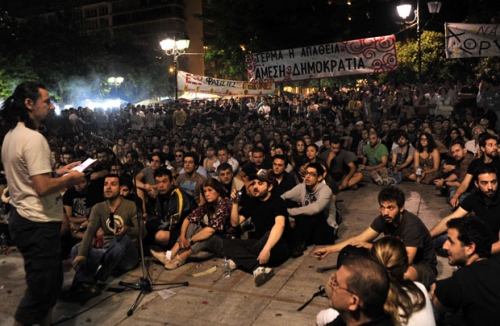
According to Marx, “supreme authority” should be vested in a “Council,” operating as “a democratic assembly, [in which] every adult male and female member had a voice upon all questions brought before it” (Ethnological Notebooks, p. 150). And yet, he assigned a central role in revolutionary politics to what he called the “dictatorship of the proletariat” (DOTP), which he suggested would undertake “despotic inroads on the rights of property.”Syntagma-square-assembly

Should we understand the DOTP as instantiating the democratic ideal as he understood it, or as suspending the democratic ideal on a “transitional” or “emergency” basis?

The concept of DOTP has been subject to multiple interpretations.

  1. According to the predictive interpretation, DOTP is an anticipated phase of social development, likely to be instituted by anti-capitalist revolution, the long-term effect of which would be to instigate a “withering away” of state power, because the basis for the state in class antagonisms would diminish as class differences were displaced by post-capitalist egalitarian forms of social organization. On this view, DOTP figures as a stage in an unfolding developmental trajectory, in which capitalist institutions are transformed into post-capitalist, socialist institutions.
  2. According to the strategic interpretation, DOTP is the only pragmatically effective organizational vehicle suited for expropriating the capitalist class and abolishing exploitation and oppression, making it strategically indispensable as a means of laying the basis for communism. On this interpretation, DOTP is a strategic proposal, to be consciously adopted as a vehicle for effecting changes that can’t be effected by means of other, less authoritative measures or organizational forms.
  3. I favour a third, normative interpretation of DOTP. In any legitimate working-class revolutionary process, “the proletariat…must constitute itself [as] the nation” (M&E 1848), i.e., as a democratic public, instituting forms of grassroots-democratic decision-making that embody the normative ideal of “public autonomy,” or what Marx (1871) called “government of the people by the people.” Marx’s account of the Paris Commune makes plain that his embrace of DOTP is founded, not upon a Realpolitik assessment that democratic norms would have to be suspended on an emergency basis by an anti-capitalist revolt, but that, on the contrary, a DOTP would itself constitute a profound deepening and broadening of democratic politics.

This last, normative interpretation of DOTP is rooted in the “social republican” understanding of Marx’s politics, an interpretation that finds much of its support in Marx’s most important text after Capital, “The Civil War in France.” The idea that public autonomy is the core normative commitment of Marx’s politics is not as well understood as we might wish. In part, this is because some Marxists have misconstrued DOTP as a prescription for domination, albeit domination of the reactionary capitalist ruling class.

But, precisely in the first volume of Capital, Marx points us in the very opposite direction. The regime of DOTP is not to be a form of “domination,” but a throwing off, by the people, of the yoke of domination: “the expropriation of a few usurpers by the mass of the people” (Capital, v. I, ch. 32). This is how Marx understood the idea of DOTP. The proletariat would “constitute itself the nation,” i.e., claim the mantle of democratic publicity, and put a stop to the domination of the people by the usurping class of exploiters. DOTP, in Marx’s sense, would be a “negation of the negation”: a “bursting asunder” of the “fetters” that block public autonomy. Thus, in no way can we think of DOTP is a repetition, or replication of the domination (Herrschaft) that we know well from bourgeois politics (i.e., “liberal democracy”). There can be no socialist state, strictly speaking, in Marx’s schema, since a regime of DOTP precludes all recourse to statism and Herrschaft. On the contrary, Marx understands DOTP as the kind of dramatic upsurge of grassroots democracy and popular self-rule that he described in his account of the Paris Commune as a “social republic.”

In a regime of DOTP, the people dictate the terms of social cooperation, in place of the rule of the usurpers. “Dictatorship” in this social-republican sense is not a prelude or transition to democracy. It is democracy, i.e., the “government of the people by the people.”

Are there ‘Good Protesters’ and ‘Bad Protesters’?

(Note: The following first appeared as a blog post at the Briarpatch Magazine website, on 12 June 2014. I re-post it here because its content is related to themes discussed on this blog. Briarpatch offers original reporting, insight, and analysis from a grassroots perspective: http://briarpatchmagazine.com/)

By Stephen D’Arcy

One of the enduring ideas to emerge from the diversity of tactics debates of recent years has been the idea that the activist left should refuse to distinguish between “good protesters” and “bad protesters.” The concern emerged in the wake of the acrimonious infighting among the organizers of the Seattle anti-WTO protests in November of 1999. After the protest, in the course of which black bloc participants had engaged in high profile property destruction (mostly targeting chain retail store windows), organizers argued bitterly about who “belongs” inside the activist left.

9uth december student cuts protests as govt votes

Some critics went so far as to claim that bloc participants were not “real protesters,” but outsiders who had no place in the movement. Unwittingly, or perhaps in some cases strategically (as a device for enhancing their own “mainstream” credibility), these organizers had adopted the rightist trope of the protester as “outside agitator” and “troublemaker,” a supposedly suitable target for police repression, unlike the “good people” whose protests are law-abiding and respectful.

The use of this language by some organizers against others, and the way it seemed to confer legitimacy on the criminalization of some protesters, led many people to highlight the toxic and self-destructive implications of accepting this good protester/bad protester distinction into the discourse of the activist left.

To be sure, mainstream journalists, editorialists, politicians, and police officers will inevitably reach for the good protester/bad protester contrast, as a way of conceding on the one hand that people have a right to protest, while insisting on the other hand that the most forceful and disruptive forms of protest deserve stigmatization and criminalization. We expect that sort of thing from the authorities and their boosters in the mainstream media. But to allow this sort of thinking into the left’s own way of talking about itself would – as the aftermath of the Seattle protests illustrated – do great damage to the activist left and its capacity to maintain solidarity against repression.

The ensuing backlash against the “bad protester” stigma was, and still is, a healthy, positive thing. It insulates the left, to some degree, from the danger of being drawn into supporting the efforts of the police to crack down on confrontational protest.

But this refusal to indulge in “bad protester” talk also carries with it a danger: that we might too crudely equate the good protester/bad protester contrast with normative thinking more generally (where “normative” means addressing what we should or shouldn’t do). The danger, in short, is that we might mistakenly assume that what needs to be rejected is all reflection and discussion about the merits of protest tactics, including their ethical merits. If we make this leap, embracing an austere amoralism, a collective refusal to think normatively and ethically about our tactical choices, we risk fatally weakening our capacity to learn from mistakes and strengthen our movements by means of critical self-reflection and debate.

Having it both ways

Can we have it both ways, however? Can we both: 1) repudiate the trope of the good protester/bad protester contrast and 2) engage in normative, critical assessment of the merits of different tactics? The answer is yes, we certainly can have it both ways. But we need a bit of clarity about what we’re doing.

First, note something about the “bad protester” idea. It does not take the form of internal self-reflection by movement participants about possible mistakes made within the movement, by some of us, our comrades, so to speak. Instead, it externalizes the (alleged) mistakes, and claims that those making certain tactical choices are not even members of our movement, but outsiders who have no place in the left. It stigmatizes them as “criminals,” “vandals,” and “troublemakers,” that is to say, as something other than co-participants in our struggles for social and environmental justice.

Karl Marx defined “critique” as “the self-clarification of the struggles and wishes of the age.” This idea, that our movements and struggles need to engage in self-clarification, by means of self-critique and internal debate, does require that we raise and debate concerns that we have about one another’s choices. We rightly argue about these things: Was that tactic helpful? Was it needlessly divisive within our own ranks? Was it too deferential to the police? Was there enough consultation with key movement allies? Did it attempt to substitute the boldness of a tiny number of people for the self-activity of a larger group, in whose name the action was taken? This kind of debate – “the self-clarification of our struggles” – is a far cry from any stigmatization of confrontational protesters as “criminals” and “vandals”; yet it is clearly and unflinchingly normative. It is reflection and debate about what we should be doing, and why.

The best militancy

Of course, there are better and worse ways to conduct this kind of discussion, and some ways seem better able to steer us away from complicity with “bad protester” stigmatization. In my book, Languages of the Unheard, I adopted a specific style of normative talk, using the concept of civic virtue as the primary normative framework. The question I addressed is, what is protest like when it is done well, at its best? Why do we admire the protester who exemplifies the civic virtue of “admirable militancy”?

By pursuing this line of questioning, I tried to give content to the idea that some militancy embodies a kind of exemplary excellence, worthy of our admiration and emulation. The best, most admirable militancy, I argued, would encourage those most directly affected to take the lead in securing the resolution of their own grievances, rather than paternalistically usurping their agency. The best militancy would enhance the power of people to govern themselves through reason-guided public discussion (typified by Assembly democracy), rather than exacerbating their domination by intransigent elites and unresponsive systems of power.

This emphasis on articulating an ideal – one which highlights excellence, but also clarifies where we sometimes go astray, succumbing to paternalism or substitutionism – avoids, in my view, the trap of complicity with “bad protester” vilification. A different, and in my view more troubling normative approach, might focus on drawing a sharp line between “permissible” and “impermissible” protest. What would worry me here is that this approach would risk allowing the focus to shift from understanding what makes excellent protest admirable, to the very different question of what people are “forbidden” or “permitted” to do, morally, as a matter of duty. This in turn would encourage us to focus on assigning blame and issuing imperatives.

In moral philosophy, we would call this a difference between a “virtue ethic” of protest and a “duty ethic” of protest. It seems clear that a virtue approach, like the one I have tried to use, is much better suited to help us navigate a course between two errors: on the one hand, a blame-fixated moralism which risks fuelling the vilification and stigmatization of confrontational protesters; and on the other hand, a crude amoralism that disavows the concepts of “better” and “worse” and thereby blocks the kind of “self-clarification of struggles” that enable movements to learn and grow.

Are there “bad protesters,” then, or not? A proper answer to this question requires a bit of subtlety. It is that sometimes resistance to injustice – which is good – can be done in ways that fall short of our best models of protest excellence, and these failures are properly subject to critical scrutiny from comrades, on a peer to peer basis. But when we criticize our fellow protesters, and when they criticize us, for (allegedly) falling short in one way or another, we should view this as one of the learning processes that our movements embrace, to make our protest more potent and more consistent with our egalitarian and democratic principles and aims.

It has nothing to do with drawing a line between “us,” the “good protesters,” and “them,” the “bad protesters,” supposedly exterior to our struggle. It is, on the contrary, a way of clarifying, collectively, how we might better conduct our common struggle against our shared adversaries. In these debates we argue with one another, often sharply and passionately, about how we might do better; we do not argue against one another, as if we were on opposite sides, or as if any of us could endorse the criminalization or demonization of our comrades in struggle.

(Stephen D’Arcy is an activist and parent in London, Ontario and an associate professor in the Department of Philosophy at Huron University College. He is author of Languages of the Unheard: Why Militant Protest is Good for Democracy and a co-editor of the forthcoming collection, A Line in the Tar Sands: Struggles for Environmental Justice.)

LOL Mayhem: A Counter-Meta-Review

(Note: The following 5,300+ word piece is a counter-review, debunking a “meta-review” which represented itself as a reply to my book review of a short book, The Worker Elite, by Bromma. Not everyone will find it worthwhile to follow this debate to the end (it ends here, below). This is a case of addressing “ants with a sledgehammer,” that is, it is an unnecessarily exhaustive and over-scrupulous refutation. If you’re looking for some more straightforward reviews of Bromma’s book, other than mine, this would be a better place to look: http://kersplebedeb.com/posts/notes-on-the-worker-eliteOn the other hand, if you have any inclination to think that the meta-review to which the following is a reply might have any merit as an assessment of my article on Bromma, or indeed any merit as an account of Bromma’s book, then you owe it to yourself to read the following from start to finish, since it decisively and with unmistakable finality settles the matter once and for all, debunking the “meta-review” in full.)

By Stephen D’Arcy

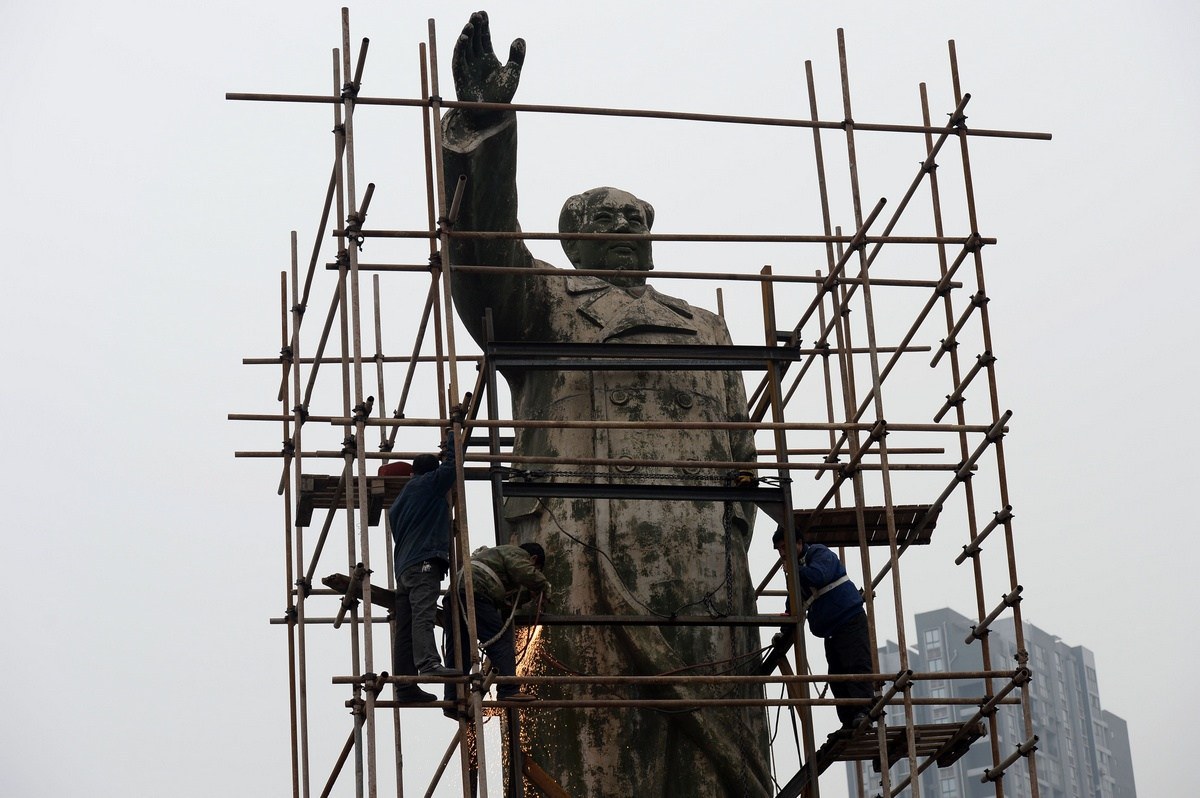
Sometimes I complain that my activity as a lefty blogger is deprived of drama by the fact that nobody ever stops to denounce my posts, even when I take up highly controversial matters, like armed struggle or allyship discourse. I can complain no longer, since now one of my posts — my book review addressing Bromma’s The Worker Elitehas been subjected to a trenchant maoist “meta-review,” which in no uncertain terms lays out the case against “the likes of D’arcy” as a disreputable falsifier of Bromma’s views. The author of this so-called meta-review, J. Moufawad-Paul, posted his reply on his well-known blog, MLM-Mayhem.mao-zedong-statue-chongqing-cultural-revolution-era-relocation-02

On no less than nine occasions, the meta-review makes a point of affixing the label “dishonest,” not simply to “the likes of D’arcy” in general, but to D’arcy himself, that is, myself, or at least my review. According to Moufawad-Paul, “the dishonesty in D’arcy’s review” is so egregious that it “borders on the laughable.”

Supplementing the dishonesty motif with a second line of attack, Moufawad-Paul’s meta-review bluntly raises the possibility that the likes of D’arcy may not have done enough to have “embedded himself in working class struggles” to be a reputable participant in a debate over Bromma’s book in the first place. After all, only someone who has properly “embedded himself [or herself]” can “speak with … concrete certainty” about these matters. “Has D’arcy even been part of a union struggle…?”

Already, this fills me with self-doubt. Maybe Moufawad-Paul is correct when he classifies my writing as “the kind of idealist fluff produced by people who have never organized in a significant manner.”

Resisting the narcissistic impulse to make it all about me, however, I will attempt to feign an unshakeable nonchalance as I breeze past Moufawad-Paul’s polemical tone-setting gestures to fix my attention firmly on those of his points that I regard as earnest attempts to advance more-or-less substantive arguments against my stated views. After all, ritual denunciation is a formal requirement of the genre (maoist polemic), so it would be absurd for me to take any of it personally. Nevertheless, I hope readers (if any) will forgive the fact that my reply consists mostly of direct quotations from Bromma’s book, a maneuver necessitated by the sheer repetitiousness of Moufawad-Paul’s depiction of my review as brazenly and almost laughably dishonest.

It may be enough if I can attempt to do two things in this reply:

  1. First, I will try to re-affirm a point which I think can be established beyond any doubt (that The Worker Elite regards South Korean auto-workers, Californian nurses, and French tire-factory workers, among many others, as privileged workers, and precisely by virtue of being so privileged, as excluded from the ranks of the proletariat, and indeed as adversaries of the proletariat and allies of the ruling class).
  1. Second, I will show that one of my supposed acts of dishonesty, of which I am so repetitiously accused by Moufawad-Paul, consists of making a claim that my meta-critic himself affirms (that The Worker Elite rejects the possibility of doing class analysis without giving any central role to the concept of privilege, since Bromma’s class theory refuses to concede, to the likes of me, that we can understand the proletariat without deploying, at the very heart of our analysis, this “non-economic” notion, as Bromma calls it).
  1. Are Seoul autoworkers, California nurses, and French factory workers members of the proletariat, or not? And, if not, why not?

This line of questioning goes right to the heart of the matter taken up by the meta-review. I claim in my review (a) that Bromma regards the “workers” in question as non-proletarian, i.e., members of a class other than the proletariat, a “middle” class with interests that are in conflict with those of the proletariat, and (b) that Bromma bases this judgment on the claim that these employee-groups derive what Bromma calls “privileges” from their access to a share of wealth exploited from actual proletarians, which in turn creates a material basis for the predictable and de facto alliance between these workers and the capitalists who grant the worker elite their “privileged” status. If I am correct in both of these claims, then it would seem that – whatever my personal failings – Moufawad-Paul’s suggestion that I have both clumsily misunderstood and, even more so, dishonestly misrepresented Bromma’s position begins to appear ill-supported by plausible evidence.

Let me begin at the beginning. Moufawad-Paul says this: “The way in which D’arcy begins his review feels quite dishonest. He lists a series of bottom-up union movements based on significant demands and claims that The Worker Elite is treating these struggles as ‘the struggles of a parasitic elite attempting to defend its unearned privileges.’” When he says this, Moufawad-Paul is replying to the following question posed at the beginning of my original review:

“If a group of unionized nurses in Oakland, California, goes out on strike, to oppose their employer’s attempt to gut their pensions and benefits; or a group of autoworkers fights with the police in Seoul, South Korea, over an employer’s plan to lay off members of their union; or if a group of tire factory workers in the French city of Amiens holds a manager hostage, to negotiate better severance packages for laid off workers — should these actions be understood as “proletarian” struggles against exploitation, which ought to be actively and vigorously supported by the socialist Left? Or are these, on the contrary, the struggles of a parasitic elite attempting to defend its unearned privileges, which have been gained largely at the expense of the actual proletariat by means of a corrupt bargain struck with the capitalist ruling class?”

Now, Moufawad-Paul seems, in this exchange, to cast doubt on my suggestion that The Worker Elite regards the union activity of nurses in Oakland, autoworkers in Seoul, and tire factory workers in France as non-proletarian struggles. If so, it would be an odd and also false (but no doubt scrupulously honest in intention) way of characterizing the content of Bromma’s book. In the case of Korean autoworkers, Bromma comes right out and says that they are members of the worker elite: “Decades ago, Japan was a trailblazer in institutionalizing a large Asian worker elite. But today it is far from unique. Heavy capitalist investment in the South Korean shipbuilding and auto industries has been accompanied by the growth of a worker elite roughly modeled on those of the West and Japan. In 2001, the average compensation costs for manufacturing workers in South Korea was almost $19 (US) an hour, according the Bureau of Labor Statistics” (pp. 37-38). Benefitting from years of “tough labor battles,” Bromma says, “unionized Korean autoworkers” now enjoy a “middle class standard of living” (p. 52; emphasis added). And these Korean autoworkers are not the only labourers who are consigned by Bromma to the ranks of the “worker elite.” “At the cultural, political, and demographic heart of the worker elite are male workers who do blue collar manual labor — teamsters, construction ‘hard hats,’ firefighters, machinists, well-paid manufacturing workers, etc.” (p. 18). Presumably the tire-factory workers in France fit precisely in this group: “blue collar manual laborers,” such as “machinists, well-paid manufacturing workers, etc.” It hardly needs to be added that nurses and teachers, too, fall in the “worker elite” class, and not in the proletariat. After all, they tend not to live in the kind of dire poverty that typifies the proletarian condition as understood in The Worker Elite. “A privileged standard of living,” Bromma says, “is a basic characteristic of worker elites,” and this “includes preferential social benefits – health insurance, pensions, vacation time, sick leave, unemployment insurance, etc. Economic privilege may also take the form of better education, home ownership, or greater access to infrastructure and services (transportation, the internet, indoor plumbing, etc.)” (p. 19). Helpfully, Bromma adds this: “Similarly, an exemption from child labor – something which is entirely ‘normal’ in the proletariat – is a characteristic of worker elite households” (p. 20).

So, I hope we can take this as basic factual information: Bromma depicts autoworkers in South Korea, nurses in the USA, and tire factory workers in France as members of the worker elite.

Why, then, does Moufawad-Paul say that my review’s opening question (about whether we should support the union activities of these groups as proletarian struggles against exploitation, or take our distance from them as struggles of a parasitic elite to defend their privileges) “seems quite dishonest”? Moufawad-Paul explains himself as follows:

“While it is true that Bromma is trying to examine the existence/persistence of a ‘parasitic elite’ in the working class, at no point is this author arguing: (a) that all union struggles are determined by this parasitism; (b) that this parasitism has to do with ‘unearned privileges’.”

Here I must object. First, Bromma is certainly not examining a parasitic elite “in the working class.” On the contrary, Bromma explicitly rejects the term “working class” as a misleading, unscientific term, because it conceals the antagonisms between what are in fact three distinct classes. The “worker elite” is not a fragment or layer within a class. It is a distinct class in its own right, according to Bromma. Bromma writes: “In fact, what is generally referred to as the working class isn’t really a single class at all, but a family of three separate classes: the proletariat, the worker elite (‘labor aristocracy’), and the lumpen working class (‘lumpen-proletariat’),” and “each has its own specific class interests and politics” (p. 4).

With that said, let’s return to the objection: Moufawad-Paul denies that Bromma believes “(a) that all union struggles are determined by this parasitism; (b) that this parasitism has to do with ‘unearned privileges’.”

Since assurance from the likes of me will hold no weight in this context, let’s look at what Bromma actually says on these points. “[I]t is an undeniable fact that the worker elite is an intrinsically parasitic class. The treasured privileges of the worker elite are funded by the ongoing capitalist exploitation of the proletariat; by the oppression of nations and women; by war, genocide, and rape of the natural environment” (p. 11). These are what I meant when I said, “unearned privileges.” Bromma observes: “That middle class status doesn’t come about because of greater skill, either. Within modern imperialism, technical education and skills are themselves privileges” (p. 12). I believe that Bromma is very clear: the relatively (in global terms) high rates of pay, the pensions, benefits, and exemption from sweatshop conditions, that characterize the “worker elite” are regarded by Bromma as flowing from that class’s “intrinsically parasitic” position: these “treasured privileges of the worker elite are funded by the ongoing capitalist exploitation of the proletariat.” I have indeed depicted Bromma as arguing that struggles to establish or defend these beneficial terms of employment, these “treasured privileges,” are rooted in a “parasitism” that “has to do with ‘unearned privileges.’” Since I stand accused of being a serial fabricator of misrepresentations of Bromma’s view, I can only invite readers to judge the meaning of some relevant passages from Bromma’s book and draw their own conclusions.

“[The] class nature [of the worker elite] is fundamentally determined by its privileges” (p. 12.)

“There’s no magic income figure delineating the boundary of the proletariat…. As we have discussed, non-economic factors are decisive in the definition of worker elites. And privilege may look different in different societies” (p. 34).

“Most of the profits that pay for worker elite privileges have come historically from colonial theft, extortion, and exploitation” (p. 36).

“Their principal economic concern isn’t survival, but maintaining and enhancing their middle class status” (p. 35).

“The more reforms the proletariat demands, the more opportunity there is for the worker elite to appropriate those reforms and turn them into privileges. Ripping off the proletarians’ struggle, the worker elite succeeds at their expense” (p. 17).

“In fact, union membership is a typical badge of worker elite status. Every day in every part of the world, worker elite unions negotiate corrupt deals with capital and trash the interests of the proletariat” (p. 62).

“Proletarians can use unions to fight oppression, to strengthen their unity and combative power. Worker elites can use unions to achieve and solidify privilege…. All these differences are political, but at the most basic level they reflect differing class agendas” (p. 62).

“The proletariat must defeat the hegemony of the worker elite’s organizations, and battle to control its own…. This multifaceted struggle will only be successful if it is understood as a deep conflict among distinct classes with different material interests, rather than as just an abstract question of program, political line or ideology” (p. 63)

“Korean auto assembly workers …still have a reputation for struggling hard against corporate attacks, including a current wave of casualization. But the terms of conflict have changed dramatically. The workers are now defending elite jobs” (pp.68-69).

“Class struggle is going on every day inside the [so-called] working class. It’s time to choose where our class loyalty lies – with the proletariat or with its minders in the worker elite” (p. 75).

“Flattering a failing worker elite with crocodile tears for its lost privileges – like the right-wing populists do – leads to disaster for the proletarian forces” (p. 57).

“The worker elite also likes to define itself as a champion of the underdog, holding the front line against the rich. This is a dishonest and self-serving narrative. In fact, the worker elite as a class embodies accommodation with the bourgeoisie and betrayal of the proletariat” (p. 52).

“[I]t is an unavoidable fact that the worker elite is an intrinsically parasitic class. The treasured privileges of the worker elite are funded by the ongoing capitalist exploitation of the proletariat….The ruling class diverts a portion of the wealth that it [exploits]…to cultivating and maintaining worker elites, which in turn are persuaded to abandon and attack the proletariat and other enemies of capital….Its prized middle class status comes from a preferential social contract, approved and paid for by the bourgeoisie” (11-12).

“The parasitic and patriarchal agenda of this [worker elite] class must be defeated” (p. 74).

On the basis of passages like these, and many more like them, I suggested at the start of my review that Bromma, in The Worker Elite, takes the view that struggles like those of US nurses to protect their pensions and benefits, of Korean autoworkers to protect their job security, and of French factory workers to secure generous severance packages, were all struggles of a privileged elite – outside the proletariat – acting to defend its unearned privileges. Was my summary of Bromma’s view “quite dishonest”? Was it even mistaken? Was it less accurate than Moufawad-Paul’s claims (1) that Bromma is investigating parasitism within the working class, rather than between antagonistic classes, or (2) that Bromma doesn’t believe that parasitism is the leading variable determining the behavior of “worker elite” unions? I leave it to the reader (?!) to judge.

But notice: I actually quote Bromma on the points in dispute, whereas – and this strikes me as an extraordinary fact – Moufawad-Paul’s “meta-review” does not quote a single sentence (let me repeat it: not a single sentence!) from Bromma’s book. We are asked to believe that he has read the book that he so insistently claims that I have misrepresented, and without hesitation or qualification I take him at his word on that score. But at no point is a single sentence, much less the dozens that one might expect, marshaled as evidence that my interpretations are mistaken. Instead, the sheer repetition of magic words like “dishonesty” and “misrepresentation” are offered in lieu of textual citation and quotation.

With this observation, I turn to the second point that I hope to establish here.

  1. Can we understand the specificity of the class position of the proletariat without deploying the concept of privilege (as I claim), or not (as I suggest that Bromma claims)?

On this point, I’m optimistic that all parties – the likes of Bromma, the likes of Moufawad-Paul, and the likes of D’arcy – can converge toward a shared understanding of where they disagree. I believe that the Bromma/Moufawad-Paul position on this specific question is that, in order to properly understand the specific class position of the proletariat, we must take note of the fact that some working people (namely, the worker elite) gain access to privileges, in the form of benefits funded by the exploitation of other, less well-paid workers (namely, the proletariat). If we fail to note this, according to (as I claimed in my review) Bromma and (it seems) Moufawad-Paul, we will mistake some non-proletarians for members of the proletariat. This, in turn, would be disastrous, at least according to Bromma as depicted in my review, because it would obscure from the proletariat itself that those teachers, construction workers, nurses and autoworkers – far from being allies (much less members) of the proletariat – are adversaries of the proletariat and allies of the bourgeoisie (the capitalist ruling class).

I don’t know whether Moufawad-Paul would agree with Bromma that nurses, teachers, construction workers and autoworkers are, to the extent that they act in accordance with their class interests, class enemies of the proletariat. Possibly not. But there can be no doubt that Bromma believes this.

Bromma writes: “The worker elite…continuously attacks, restricts, and undermines the proletariat’s struggle for freedom. The predominantly reactionary role of this privileged class flows directly from its material interests” (p. 75).

“Along with their fellow middle classes, the worker elite everywhere makes defense of privilege their top priority” (p. 55).

“[T]he labor elite is always looking to augment its privileges, and will routinely betray the proletariat to gain more” (p. 54).

“When the worker elite wishes to employ the proletariat for leverage, its ‘anti-establishment’ aspect and rebellious rhetoric may come to the fore…At the same time, true to its fundamental class nature, the worker elite will work to control, manipulate, and eventually defeat such rhetoric” (p. 46).

“It’s time to choose where our class loyalty lies – – with the proletariat or with its minders in the worker elite” (p. 75).

But while Moufawad-Paul can’t plausibly substantiate any doubt that Bromma thinks of the worker elite as aligned with capital in a class struggle against the proletariat, which the proletariat must defeat, there is a further, slightly more subtle point to be addressed. Was I misrepresenting Bromma when I said that The Worker Elite uses “a privilege approach to class analysis”?

Here’s the relevant passages (describing the privilege approach to class analysis) from my review:

“In the privilege approach, class is understood as a location in a system of differences, but not primarily, or at any rate not exclusively, as a two-way antagonism between boss and worker. Just as important as the boss/worker conflict, from this point of view, is the antagonism or differentiation between differently located groups of workers. The differences between them — that is, the ‘privileged’ position of some working people, which sets them apart from other workers — may very well, according to this approach, necessitate that we treat differently positioned workers as constituting different, antagonistic classes: a privileged class of elite workers that benefits from unearned advantages that are denied to members of the genuinely ‘proletarian’ class of workers.… In contrast to the exploitation view, the privilege conception of class encourages us to view advantages or gains made by some (but not all) groups of working people, not positively, as ‘victories for our class,’ but rather negatively, as unearned advantages, subsidized by the continuing impoverishment of the lower paid, less advantaged workers.” (Quoted from my review of Bromma.)

Now, Moufawad-Paul could not credibly cast doubt on my attribution to Bromma of the view (1) that the worker elite is not part of the proletariat, (2) that it isn’t in the proletariat because it has special privileges to which the proletariat is denied access, and (3) that these privileges are subsidized or “funded” (as Bromma puts it) by the impoverishment and exploitation of proletarians, which (4) renders the worker elite a parasitic class. This analysis, as I have established here by means of extensive quotation, is clearly a key theme in Bromma’s book. But what Moufawad-Paul does want to dispute is that we can usefully distinguish between an exploitation approach and a privilege approach to class analysis.

Moufawad-Paul writes: “What Bromma is actually saying is that exploitation (yes, D’arcy, exploitation) is what determines the stratification of the working-class at the centres of capitalism and elsewhere, thus producing a measure of privilege for some workers due to the greater exploitation of others. The entire analysis [of Bromma] is driven by a theory of exploitation, which is treated as something that generates differentials of privilege, and so the entire ‘privilege vs. exploitation’ narrative concocted in this review [by the likes of D’arcy] is off-the-mark. Are there workers who are more exploited than other workers, and are there workers who benefit from the exploitation of their counterparts? This is one question The Worker elite attempts to address.”

Other than the part about my review being “off-the-mark,” I agree with this comment, at least most of it. I say in my original review that Bromma’s worker elite is “parasitic” precisely because it benefits from the exploitation (yes, meta-critic, exploitation) of the proletariat. I say this at least twice. The first time I say it is when I quote Bromma’s claim that “the treasured privileges of the worker elite are funded by the ongoing capitalist exploitation of the proletariat,” and that “the ruling class diverts a portion of the wealth that it [exploits]… to cultivating and maintaining worker elites, which in turn are persuaded to abandon and attack the proletariat and other enemies of capital….Its prized middle class status comes from a preferential social contract, approved and paid for by the bourgeoisie” (Bromma, p. 11-12, here presented as quoted in my review.) The second time I make the point is when I write: “Bromma…views class mainly through the lens of the concept of privilege. (I say ‘mainly,’ because Bromma does make use of the concept of exploitation, but it has a secondary role, largely to support the book’s analysis of ‘worker elite’ privilege).” Thus, I do acknowledge that Bromma uses the concept of exploitation in the “worker elite” class analysis. However, I say it has a “secondary role.”

Is the role of the concept of exploitation really “secondary” in Bromma’s approach to class analysis? And is the concept of privilege really primary in that approach? What Moufawad-Paul claims — I think — is that these two concepts are not really separable: that, in order to analyze class exploitation properly, we have to use the concept of privilege. Although I disagree on the substance of that claim, I take heart in the fact that, by taking this view, Moufawad-Paul has come around to endorsing the interpretation of Bromma (as insisting that class analysis needs to foreground privilege) that I offered in my review. In other words, Moufawad-Paul seems, unless I’m up to my old tricks, etc., to be saying that, for Bromma, you can’t analyze class with using the concept of privilege. This is, very precisely, the view that in my review I dubbed “the privilege approach to class analysis.”

That privilege approach does not reject exploitation. But it denies that two groups of workers that are both exploited by the capitalist class in the same general way (as wage labourers, employed via the labour market to work for capitalist firms) are just for that reason members of the same class. According to the privilege approach, a further crucial question has to be asked, before we can analyze the class position of these two groups. Is one of the groups privileged, in the sense of gaining access special advantages, like health insurance, pensions, a living wage, job security provisions in a collective agreement, etc., privileges which (according to Bromma) are “funded” by capitalist exploitation of the other group of workers? If so, then these are not two ‘layers’ or ‘sections’ of one class – the proletariat. Instead, one of these groups of employees are proletarians, and the other – the privileged group – are not proletarians, but members of a “middle class,” a “worker elite,” which has interests that are antagonistic to those of the proletariat.

I take it that this is the view that both I and Moufawad-Paul attribute to Bromma: that we can’t analyze class positions without deploying, at the heart of our analysis, the concept of privilege. I call it the “privilege approach.” I concede that my terminology is not that of either Bromma or Moufawad-Paul. But I certainly do not concede that I have in any way misrepresented Bromma’s view. I have not, for instance, made Moufawad-Paul’s apparent mistake of thinking that Bromma regards the worker elite class as simply having “non-proletarian consciousness.” No, clearly Bromma regards the worker elite as a different class, whose interests are antagonistic to those of the proletariat, quite apart from their “consciousness.” When Bromma calls the worker elite “an intrinsically parasitic class,” the idea is not that they have “non-proletarian consciousness.” It is that they benefit from the exploitation of the proletariat, and that they have therefore a material interest in maintaining the subordination of the proletariat, in collaboration with the capitalist class. The conflict between the proletariat and the worker elite, Bromma says, is “a deep conflict among distinct classes with different material interests, rather than…just an abstract question of program, political line, or ideology” (p. 63).

Having established that my attribution to Bromma of the view that we can’t do class analysis without using the concept of privilege (as a necessary supplement and corrective to the concept of exploitation, which might make a construction worker or a factor worker seem like a proletarian, which would be disastrous according to Bromma), I want to draw the discussion to a close by underlining the point where we disagree. I believe that exploitation is not co-central (alongside privilege) in Bromma’s class analysis (which I think is what Moufawad-Paul is trying to say), but firmly consigned to a secondary role. Since my testimony is tainted in this setting by the profusion of dishonesty charges, I will — as above — mostly just quote Bromma’s statements on this issue.

To say that “privilege” is primary and “exploitation” is secondary in someone’s approach to class analysis is to say this: that economic factors, e.g., exploitation, are not treated by them as decisive variables in assigning a group of people to a class, and that non-economic factors, notably privilege, are instead treated as the decisive variables. I regard this as, if not an obvious way to interpret “primary” and “secondary,” at least a non-eccentric way to interpret these terms. If this makes me dishonest, in the maoist frame of reference, then so be it. I take my stand here: I claim that anyone who regards privilege, not exploitation, as the decisive variable in assigning a group of employees to a class, thereby treats exploitation as secondary, and privilege as primary.

Having said that, I can get right to the point: Bromma comes right out and says that economic factors, e.g., exploitation, are not decisive in class analyis (specifically, in determining the boundaries of the proletariat), and that privilege is instead decisive.

Let’s look at Bromma’s words:

“There’s no magic income figure delineating the boundary of the proletariat…. As we have discussed, non-economic factors are decisive in the definition of worker elites” (p. 34).

But which “non-economic factors” are “decisive”? Bromma replies: “[The] class nature [of the worker elite] is fundamentally determined by its privileges” (p. 12).

Bromma adds, even more bluntly: “The worker elite is a mass class, comprising hundreds of millions of middle class workers around the world whose institutionalized privileges set them decisively apart from the proletariat. In short, entitled middle class workers” (p. 5; emphasis added).

Note two things about this passage: first, it the “institutionalized privileges [which] set them [the worker elite] decisively apart from the proletariat.” Hence, if it is dishonest for me to say that according to Bromma privilege is decisive in setting industrial and white collar workers in places like Korea or Canada apart from the proletariat, how much more dishonest must Bromma be, since Bromma has inserted these very words into the opening pages of the book! Second, note, too, that Bromma accepts, indeed introduces, the summary formula: “entitled middle-class workers.” Was that my mistake? That I said “privileged” instead of “entitled”? Was this my “quite dishonest” “misrepresentation”? If so, then, once again, Bromma is the worse offender, since the label “privileged” is applied to the worker elite again and again in the pages of The Worker Elite, as I have shown, and by no means only in the quoted passage about how “institutionalized privileges set them decisively apart from the proletariat.”

Even Moufawad-Paul himself insists, re-stating the point that I had attributed to Bromma both in my original review and in this rejoinder, that the class location of the “worker elite” is determined by “a differential of exploitation that produces a differential of privilege” (Moufawad-Paul). This formula demonstrates the key point: that exploitation gains its importance precisely because it generates what Bromma calls the “non-economic factor” which is “decisive”: “institutionalized privileges [which] set [the worker elite] decisively apart from the proletariat.”

Conclusion

Needless to say, I could go on. And on. If nothing else, I have proven that. I had thought that it would be fitting to make the length of this counter-meta-review exceed the 75 pages (with large font and photographs) of Bromma’s book itself. I even imagined a scenario where I would include the entire book within my counter-meta-review, one quoted passage at time. But I have a job and kids, so for now, I will cut it short, with the teasing promise that I may add further instalments, if the appetite of readers for a more thorough examination proves too great to ignore.

I should probably end with the question that began my original review:

“If a group of unionized nurses in Oakland, California, goes out on strike, to oppose their employer’s attempt to gut their pensions and benefits; or a group of autoworkers fights with the police in Seoul, South Korea, over an employer’s plan to lay off members of their union; or if a group of tire factory workers in the French city of Amiens holds a manager hostage, to negotiate better severance packages for laid off workers — should these actions be understood as ‘proletarian’ struggles against exploitation, which ought to be actively and vigorously supported by the socialist Left? Or are these, on the contrary, the struggles of a parasitic elite attempting to defend its unearned privileges, which have been gained largely at the expense of the actual proletariat by means of a corrupt bargain struck with the capitalist ruling class?”

Bromma, clearly, takes the second view: that such struggles are those of a parasitic elite attempting to defend unearned privileges, which it secures by way of an alliance with capital against the proletariat. This is an interesting claim. If it were convincing, it would have far-reaching consequences, many of which Bromma makes explicit (e.g., that we would have to choose which class we want to support in the class struggle between proletarians and the worker elite, including the construction worker chosen to illustrate that supposedly parasitic elite on the cover of Bromma’s book). That it advances, in clear and unflinching detail, such a provocative and interesting claim is reason enough to read Bromma’s book. Contrary to Moufawad-Paul’s suggestion, I don’t urge people to avoid reading the book. But let there be no doubt about this: I think Bromma’s central claims are mistaken. To the extent that they become more influential, I would think this a bad thing. But it has never occurred to me to suppose that dishonesty was needed to debunk those claims. We have marxism, i.e., “social scientific socialism,” to do that, and misrepresentation would only get in the way.

The Intractable Marginality of the Activist Left

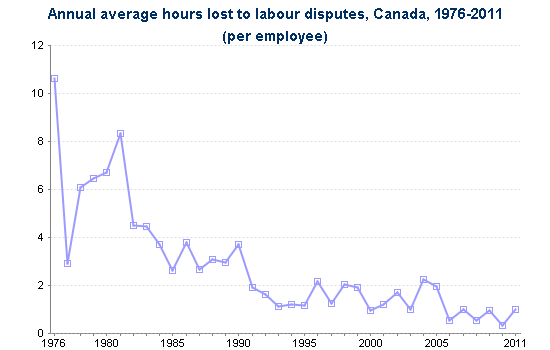
Strikes are only one form of struggle, and perhaps less and less important as the years pass. But the disappearance of strikes — documented in the accompanying graph — is not an anomaly. It reflects a pattern of diminishing overall levels of oppositional social mobilization. Although there aren’t (as far as I know) statistics on it, it is obvious that levels of social struggle generally, in the Canadian state, are lower now than at any time since written records have been kept. There was, to be sure, an upswing during 2011-12, which saw important outbreaks of Indigenous protest (INM, pipeline and fracking struggles, etc.), the Occupy movement, and the Quebec student strike, but this partial revival of large-scale popular protest proved to be short-lived. And there are still, as always, ongoing forms of low-intensity resistance, punctuated by occasional outbreaks of popular defiance and rebellion. Overall, however, the aggregate level of oppositional social struggle in recent decades has been disastrously low.strike-levels-over-time

Since participation in social-movement struggles is basically the only setting (other than a few university courses and a few tiny and isolated leftist groups and collectives) where people have the opportunity to learn about leftist ideas and strategies, the radical Left is trapped in a position of intractable marginality, lacking any plausible path to “mainstream” relevance, i.e., any capacity to secure a meaningful role in shaping the ideas of large numbers of people or wielding any substantive influence. In this sense, there has been a deep and broad collapse of what Marx called popular “self-activity” (“Selbsttätigkeit”) — a terrifying lack of self-organized struggles of broad masses of people for social and environmental justice. We lack, therefore, the expansive pool of social antagonisms and conflicts upon which the Left could in former decades rely for infusions of enthusiasm, critical insights about the nature of the systems we oppose and how to defeat them, and what Rosa Luxemburg called “the forward-storming combative energy” of broad popular movements.

First of all, this collapse of self-activity has to be acknowledged as an accomplished fact. Blaming the activist Left for its own marginality is like blaming the dead fish when a pond dries up after years of catastrophic drought. The pathologies of the Left — chronic sectarianism, exaggerated levels of self-doubt (self-hatred?) about the utility of leftist politics, incapacity to engage with a broad public outside of leftist subcultures, the near total shift of focus from organizing against systemic racism and sexism to obsessing about racist or sexist utterances by celebrities or public figures as these are debated on social media, and so on — these are all symptoms, not underlying causes, of the fact that the levels of social struggle are so low that the Left has no context, no “habitat” (so to speak) in which to operate on a healthy basis. Inevitably, it shrivels up and loses its former vitality and dynamism. It is cut off from everything that once nourished its growth and vigour. To be sure, we can offer the usual self-critiques. But let’s not allow our thinking to be unduly clouded by naive hopes for a tiny and isolated, yet healthy and dynamic activist Left. This is a deeply incoherent expectation.

Second of all, we really should try to develop a healthy respect for our own utter dependence, as radical leftists, on events that remain almost entirely beyond our control. By its very nature, the radical Left can only play a constructive role if there are broad-based popular struggles with which it can engage, and by which it can be transformed. But it can never — and certainly not now — manufacture such struggles by force of will or by sheer organizing prowess. It has to wait, more or less helplessly, for relevance to be thrust upon it by events (even if it is condemned to be incapable of admitting to itself how limited its capacities really are — after all, who likes to admit to being helpless?).

But this respect for our dependence on levels of popular self-activity that we cannot effectively generate by our own devices also entails some guidelines about how to think about the challenges we face. The struggles on which alone the Left can base its regeneration will not come from the radical Left itself. But the Left itself has to cultivate a capacity to recognize them when they do appear. This was something we learned during the emergence of the Occupy movement. It took weeks for some ‘old school’ leftists, and months for others, to recognize it as an important social struggle. (Many still doubt this.) One recalls the reaction of 1950s leftists to the emergence of Students for a Democratic Society and, a few years later, the Black Panther Party. Many leftists of the previous generation did not even recognize these as key opportunities for the Left to secure a new importance and relevance for radical politics, which it largely lost during the 1950s. Instead, they insisted that these upstart organizing initiatives were “doing it wrong,” i.e., too distant from the the way the Left looked in earlier decades. When a healthy Left re-appears in the context of future broad-based movements, it will be because it puts into practice the old Boshevik slogan: “Study the old, create the new.”

And yet, even the Occupy movement remained far too small in scale, compared to the levels of popular self-activity that would be needed to offer the radical Left a new viability for its project of destroying racism, sexism, colonialism, and capitalism. So our eyes have to be fixed on any signs of broad-based popular mobilization, especially when it reaches beyond the ranks of radical “scenes” and “subcultures,” whether these be anarchists punks, marxist grad students, or loose networks of ‘social justice’ advocates on twitter or tumblr. That, however, is the scary part of all this. This idea that the Left has to wait for something (1) that doesn’t now exist, (2) that the Left can’t create by its own efforts, and (3) that seems only likely to emerge from struggles of a sort that happen less and less often, and seemingly on an ever smaller scale. It’s terrifying, of course. But it’s the only reality we have, and we have to begin by acknowledging it.

Ideally, we will draw the crucial lesson from these developments: that struggles are precious, and that broad-based struggles that draw in hundreds of thousands of people from outside the ranks of our activist scenes and subcultures, are especially precious. Only these can save us. On the other hand, our very predicament — our intractable marginality — makes it perhaps more likely that we’ll draw the opposite conclusion: that most people are ‘sheep,’ or that they are ‘not the real proletariat,’ but a privileged elite that stands in our way, etc. Our marginality, in short, makes it likely that we will remain largely oblivious to our need to be rescued by a hoped-for resurgence of broad-based mobilizations reaching, and indeed orginating, well beyond our own ranks. The actually existing radical-activist Left tends to respond to adversity by digging in its heels, insisting all the more confidently that it already has all the answers it could ever need, if only people would listen.

Still, looking on the bright side, the irrelevance of the activist Left limits the damage that its pathologies can do. When large-scale, sustained, and broad-based popular mobilization returns — as surely it must, eventually, albeit not necessarily soon enough to avert catastrophe — the scenes and subcultures of today’s activist Left will be swept away and replaced in the same way that those of the 1950s Left were swept away and replaced in the 1960s. But what can we do, today, that will leave something useful behind for those who will one day cast aside our present-day fixations as they build something that we remain unable to foresee?